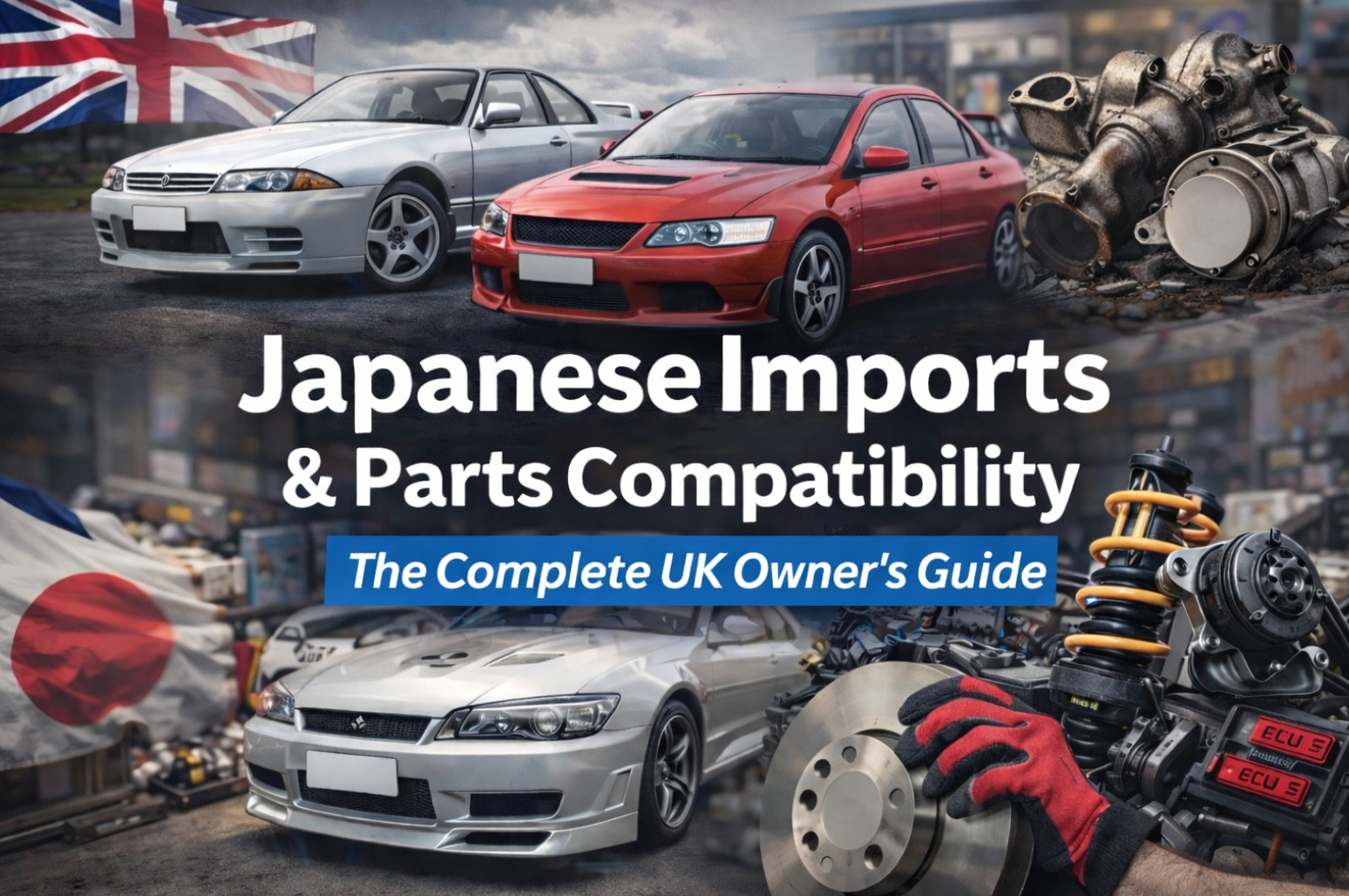
Japanese Imports & Parts Compatibility: The Complete UK Owner’s Guide
2 Feb 2026
Japanese Imports & Parts Compatibility: The Complete UK Owner’s Guide
The Real-World Guide Every UK JDM Owner Needs
Last updated: February 2026
There’s a moment most Japanese import owners remember. It usually happens the first time you need a part. You’re confident. You know your car. You know the model, the year, the trim. You jump online, order what looks right… and then it arrives. And it doesn’t fit. Not even close. That moment is when you realise something important: Owning a Japanese import isn’t like owning a standard UK-spec car. And while that’s part of the magic, it’s also where many enthusiasts hit frustration. This guide isn’t written for search engines. It’s written for real owners, the ones who love their cars, plan to keep them long-term, and want to do things properly. Because when it comes to Japanese imports, parts compatibility is one of the most misunderstood topics in the UK car scene. Let’s break it down properly.
Why Japanese Imports Have Such a Loyal Following
Japanese imports aren’t just vehicles, they’re culture, engineering, and history.
People gravitate toward them for different reasons:
Some love the performance pedigree.
Some love the rarity.
Some appreciate the over-engineered reliability.
Others simply want something different from the UK mainstream.
And often, Japanese domestic models came better equipped than their UK equivalents. Higher trims, better interiors, more advanced tech for their time, it’s no surprise they’ve built such loyal communities.
Cars like the Skyline, Supra, RX-7, Evo, and Type R models didn’t just become popular, they became icons. But with that uniqueness comes complexity.
The Truth About Parts Compatibility (That No One Tells New Owners)
Here’s the honest truth:
Two cars can share the same badge and still require completely different parts.
And this is where many new import owners get caught out.
Manufacturers often produced multiple variants of the same model for different markets. On the surface, they look identical. Underneath, they can be very different machines.
Differences might include:
-
Engine internals
-
Electronics and ECUs
-
Wiring looms
-
Brake setups
-
Suspension geometry
-
Sensors and connectors
-
Emissions equipment
-
Interior trim and fittings
So while your car may be “a 1999 model,” that alone isn’t enough information when sourcing parts.
Why Chassis Codes Matter More Than Model Names
Experienced import owners don’t rely on model names, they rely on chassis codes.
A chassis code tells you exactly what you’re dealing with, production variant, drivetrain configuration, platform details, and sometimes even the factory batch.
For example, saying “I have a Subaru Impreza” is too vague. A GC8 vs a GDB can mean completely different compatibility. Same goes for S13 vs S15, JZX90 vs JZX100, or R32 vs R34 variants.
Two cars can share a name yet share surprisingly few parts. This is why knowledgeable sellers always ask for chassis codes first.
Electronics: The Silent Compatibility Killer
Mechanical parts are one thing. Electronics are another story entirely.
Japanese imports frequently differ in wiring standards, sensor types, and ECU calibrations. Even small connector variations can make a part unusable.
A sensor from a UK-spec car may physically fit but communicate differently with the ECU. That can lead to warning lights, poor performance, or intermittent faults that are incredibly hard to trace.
It’s one of the main reasons experienced import owners avoid guesswork.
The Myth of “It Should Fit”
If there’s one phrase that causes more headaches than any other in the import world, it’s this: “It should fit.” Should and will are two different things.
A part might fit physically but not function correctly. Or it may require modifications that cost more than buying the correct part in the first place.
This is why seasoned owners verify part numbers instead of assuming compatibility.
OEM vs Aftermarket vs Used - What Actually Makes Sense?
Japanese import owners often use a mix of all three. The smart approach depends on the part.
OEM parts are ideal when precision matters - sensors, engine components, electronics. They’re reliable and built to exact tolerances, but they can be expensive and sometimes discontinued.
Aftermarket parts make sense for upgrades. Suspension, performance braking, and styling modifications often benefit from reputable aftermarket brands. But quality varies widely, and fitment can differ.
Used parts are incredibly valuable in the import world. Many rare components simply aren’t produced anymore. Good-condition used parts can be the best and sometimes only option.
The key is buying from sellers who actually understand what they’re selling.
Why Finding Import Parts Is Still Hard in the UK
Despite the growth of JDM culture, sourcing parts can still be challenging. Many vehicles were produced in limited numbers. Some parts were never meant for export markets. Others were discontinued years ago.
Owners often bounce between forums, social groups, and overseas suppliers trying to piece things together. That works… but it’s not efficient.
And it’s why specialist marketplaces have started becoming more important in the scene.
The Rise of Smarter Parts Sourcing
Today’s enthusiasts are more informed.
They want:
-
Clear listings
-
Accurate compatibility info
-
Access to specialist sellers
-
Rare and discontinued parts
-
The ability to request hard-to-find items
They’re moving away from random classifieds and toward dedicated platforms where sellers and buyers actually speak the same language.
Because the reality is simple: The right part saves time, money, and frustration.
Demand Data Is Shaping the Future of Parts
Something interesting is happening in the automotive world right now. Demand data is influencing supply.
When enough owners search for specific parts, it signals real demand. That information can influence remanufacturing decisions and supplier priorities.
In other words, enthusiast demand is starting to shape what gets reproduced. For rare and classic Japanese imports, this matters more than ever.
Advice for New Import Owners
If you’re new to Japanese imports, the best thing you can do is treat parts sourcing like research, not guesswork.
Keep records of your chassis code and engine code. Save OEM numbers when you find them. Learn from communities and experienced sellers.
Most importantly, buy from people who understand imports, not just generic car parts.
Why This Matters Long-Term
Japanese imports are becoming modern classics. Some are already appreciating. Others are being preserved as collector cars. Many are long-term passion projects.
Keeping these vehicles on the road requires access to the right parts and the right knowledge. Because once a car is sidelined due to parts issues, it rarely returns to the road easily.
How ifndautoparts Fits Into This
ifndautoparts was built around a simple idea: Great parts shouldn’t sit unused while owners struggle to find what they need.
The platform connects enthusiasts, specialists, and dismantlers in one place. It allows rare stock to circulate and helps owners keep their cars alive.
And for Japanese imports, that ecosystem matters. Because these cars deserve longevity, not frustration.
Owning a Japanese import is rewarding because it’s different. It requires more knowledge, more care, and sometimes more patience. But that’s also what makes it special.
When you understand compatibility, use the right sources, and connect with knowledgeable sellers, ownership becomes far smoother. And as the import scene continues to grow, the support network grows with it.
ifndautoparts is a UK-based specialist marketplace for buying and selling OEM, aftermarket, and used car parts. Supporting Japanese imports, performance vehicles, and classics, the platform connects enthusiasts with trusted sellers to make sourcing parts easier and more transparent. Built by car lovers, for car lovers.
2 Feb 2026
Tags